Noxious Weed Board
Help Us Stop the Spread of Spurge Laurel in Lewis County
Lewis County Noxious Weed Control staff have been actively surveying for spurge laurel (Daphne laureola), an invasive evergreen shrub and Washington State Class B noxious weed. Although currently limited in its distribution within Lewis County, spurge laurel has the potential to spread and establish itself in wooded areas, forest understories, and other natural habitats.
Because this plant is still relatively uncommon in our county, early detection and control are a high priority. Finding and eliminating existing populations before they have an opportunity to spread is one of the most effective ways to protect our native vegetation and prevent a much larger problem in the future.
As part of these efforts, some Lewis County landowners may have already received a letter from our office requesting assistance with identifying and controlling spurge laurel on their property. We appreciate the cooperation of landowners who are willing to work with us to address this invasive species.
**LANDOWNER ALERT: Have you received a letter from Lewis County Noxious Weed Control about spurge laurel? Your cooperation is important! Early control is critical to preventing this invasive plant from becoming established throughout Lewis County.
Originally native to Europe and northern Africa, spurge laurel was introduced to North America as an ornamental landscape plant. It has since escaped cultivation and established itself in natural areas throughout the Pacific Northwest.
Spurge laurel is particularly concerning because it tolerates a variety of growing conditions, including shady forest understories. Once established, it can form dense patches that compete with native vegetation for growing space, light, and resources.
Birds are attracted to its dark berries and help spread the seeds into surrounding natural areas, making it especially important to remove plants before they produce mature fruit.
Spurge laurel is an evergreen shrub that typically grows between 1.5 and 5 feet tall. Its distinctive foliage makes it relatively easy to recognize once you know what to look for.
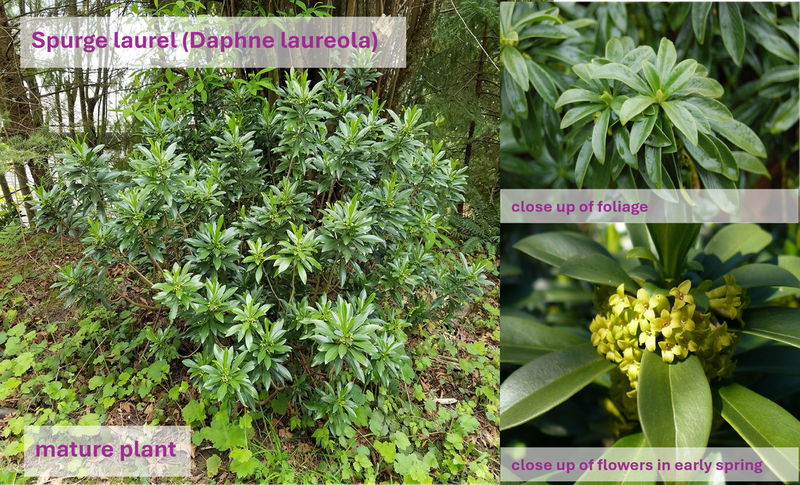
Here are some key identification characteristics:
- Leaves: Dark green, glossy, leathery leaves that are lighter underneath. Leaves are narrow and oval-shaped, generally 1–5 inches long, and are arranged in spirals, with the greatest concentration near the ends of branches.
- Flowers: Small, inconspicuous yellow-green flowers appear in clusters near the base of the leaves. They are often fragrant and typically bloom in late winter and early spring.
- Fruit: Small, oval-shaped berries develop following flowering. They transition from green to dark bluish-black as they mature.
- Stems: Young stems are green, while mature bark develops a grayish color with yellow tones.
- Growth habit: An upright or spreading evergreen shrub, generally found growing in wooded areas, forest edges, and partially shaded locations.
A word of caution: All parts of spurge laurel are toxic to humans and animals. The sap can also cause skin and eye irritation. Avoid handling the plant with bare hands and keep children and pets away from plants and berries.
How to Control Spurge Laurel
The good news is that smaller infestations can often be managed successfully with physical removal. The most important consideration is removing the entire root system and preventing plants from producing and spreading seeds.
Mechanical Control
- Small seedlings can be hand-pulled, preferably when the soil is moist.
- Larger plants can be dug out or removed using a weed wrench or similar extraction tool.
- Plants that are too large to pull can be cut below the soil surface.
- Monitor previously treated areas for new seedlings and regrowth. Spurge laurel can resprout from remaining roots, so follow-up control is important.
Always wear appropriate protective equipment, including gloves, long sleeves, and eye protection when working around spurge laurel. Avoid direct contact with plant sap.
Herbicide Control
Herbicide treatments may also be an option for established plants or infestations where mechanical removal is impractical. Treatment methods and product selection depend on the size of the infestation and surrounding vegetation.
Consult the Pacific Northwest Weed Management Handbook or contact Lewis County Noxious Weed Control for recommendations before applying herbicides. Always follow the product label.
Proper Disposal
Take care when disposing of removed plants, particularly those with developing or mature berries. Avoid spreading seeds during removal and transport. Bag fruit-bearing material and follow local disposal guidance. Do not compost plants where seeds could potentially be redistributed.
Help Us Keep Spurge Laurel from Spreading
Our ability to prevent invasive weeds from becoming established throughout Lewis County depends heavily on early detection and cooperation from local landowners.
If you have received a letter from Lewis County Noxious Weed Control regarding spurge laurel, we encourage you to take a few minutes to inspect your property and follow through with the recommended control efforts.
If you believe you have found spurge laurel on your property but aren't sure, please contact our office before attempting removal. Our staff can help confirm identification and provide recommendations for appropriate control methods.
Even if you haven't received a letter, we encourage everyone to keep an eye out for this invasive shrub, particularly in wooded areas and forest understories.
A little effort today can prevent a much bigger problem tomorrow. By working together, we can protect the native plants, wildlife habitat, and natural beauty that make Lewis County such a special place.
Questions or need assistance? Contact us!
Contact Info:
125 NW Chehalis Ave (physical)
351 NW North St (mailing)
Chehalis,
WA,
98532
Education & Outreach: 360 740 1218
Email: weeds@lewiscountywa.gov
Hours: 8 a.m.–4 p.m. Monday thru Friday (available by appointment)