"I Was Just Doing My Job"
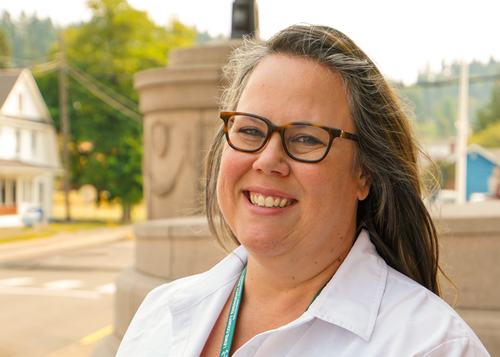
How Erika Katt stood with Longview’s grieving families after the deadliest workplace disaster in Washington in nearly a century
The call came early. It was just before 7:15 a.m. on a May morning when a 900,000-gallon tank of white liquor imploded at the Nippon Dynawave Packaging mill in Longview. White liquor is the caustic solution a pulp mill uses to break wood chips down into fiber. Roughly half a million gallons of it came through the plant as a wall. Eleven workers were killed. It would become the deadliest workplace disaster in Washington state in nearly a hundred years.
Erika Katt, deputy director of Lewis County Emergency Management, did not know most of that yet. She only knew that a neighboring county had asked for help, and that in emergency management you answer that call the same way you would want yours answered. “With emergency management, we help each other,” she said. “Cowlitz called and requested.” By that afternoon she was in Longview, and she would stay for a week.
Katt’s assignment was to help stand up the Family Assistance Center and run it. In the middle of chaos, rumor and grief, its purpose was simple and singular. “Our sole mission was to take care of the families,” she said. “That’s all we were doing.”
She and her partners built the center at the union hall and set firm rules to protect the people inside it. No elected officials. No media. No onlookers. Family only, and the coworkers who were family too. “We were trying to make them a safe space to go,” she said. It was a place to sit at a table, or find a shoulder to cry on, or to yell and scream at someone who would stand there and take it. “It was a place, a safe place for people to go through the grieving process.”
Doing that work meant coordinating a hard web of partners at the worst moment of these families’ lives: the Cowlitz County Coroner’s Office, the Cowlitz County Chaplaincy, Columbia Wellness, Cowlitz County Emergency Management, Cowlitz County Social Services and a large, fiercely supportive union. It helped, Katt said, that she already knew many of the partners. Those relationships carried real weight when everything else was uncertain.
Because the spilled material was so corrosive, recovery was slow and painstaking. It took days to safely reach the workers still inside. The team worked the whole arc of it, from the first hours through the final recovery that Saturday.
Some of the hardest work was managing what the families were told, and when. As each worker was found, notifications went out to all families. For some, that wait stretched for days. “It was hard,” she said. “It was difficult.” Her team also had to gently push back on the false hope carried in by rumors.
“We went from the moment it happened, trying to get these people reunited with their families, all the way to attending the funerals. Because by then, we’re those people too.”
The work did not end at recovery. Katt stayed through the processions and the funerals, helping make sure the wider community had a way to pay respects. Not everyone could attend a funeral, and not everyone was comfortable doing so, but they could stand for a procession. “The community needed a place to recover as well.”
Along the way it became personal. One of the families she was helping turned out to be tied to someone Katt already knew from her own work in local government. “It actually became real for me too,” she said. “Now I know someone.” She also grew close to two union representatives, and weeks later, they still text. “They’re my people now.”
Katt does not think of any of this as heroism, and she is uneasy being singled out for it. When asked how she responded when the county recognized her, she deflected almost on reflex. “I’m just doing my job,” she said. “It’s part of what we do. It’s what we do as public servants, it’s what we do.”
She is honest that the work cost something: her family, holding down the fort and caring for the kids while she was away. Some have asked why she would take it on, warning she would not come back the same. Her answer says a lot about who she is. “Well,” she said, “it’s what I do and I would hope I’d be better because of it.”
She did come back with something. Katt returned to Lewis County carrying folders of hard-won lessons, new procedures and relationships across agencies that will not go away.